
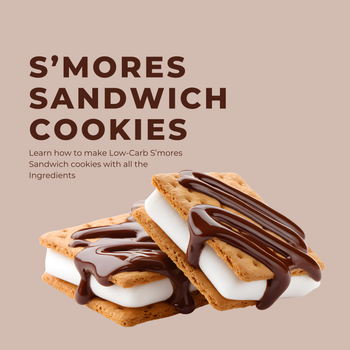
These sandwich cookies pair a crisp almond-flour graham cookie with a marshmallow-flavored mascarpone filling and a sugar-free chocolate ganache. The recipe makes 6 sandwich cookies at roughly 4–5 g net carbs each, and takes about 45 minutes including cooling.
No campfire, no graham crackers, no 22 grams of sugar per s'more.
Why This Version Works
Most low-carb s'mores recipes fail at the cookie. Almond flour has no gluten, so it spreads and crumbles unless something binds it — that's what the xanthan gum and egg white are doing here. And most keto marshmallow substitutes involve gelatin, a candy thermometer, and a stand mixer, for a result that weeps within a day.
Skipping that entirely: a mascarpone filling flavored with marshmallow concentrate delivers the same toasted-vanilla note, holds its texture in the fridge for days, and takes ninety seconds to make.
The earlier version of this recipe used a microwave method with unmeasured filling. This one is measured, baked, and gives you the net carb math so you can check it against your own brands.
Ingredients
Graham-Style Cookies (makes 12 cookies / 6 sandwiches)
- 3/4 cup (84 g) blanched almond flour
- 1/4 cup (48 g) brown-style granular sweetener
- 1 tsp ground cinnamon
- 1 tsp baking powder
- 1/2 tsp xanthan gum
- 1/4 tsp fine salt
- 3 tbsp (42 g) butter, browned and cooled
- 2–3 tbsp egg whites
- 2–3 drops graham cracker flavor concentrate (optional but recommended)
Marshmallow Filling
- 1/2 cup (115 g) mascarpone, softened to room temperature
- 2 tbsp powdered sweetener
- Pinch of fine salt
- 2–4 drops marshmallow flavor concentrate
Chocolate Ganache
- 3 oz (85 g) sugar-free dark chocolate chips
- 3 tbsp (45 ml) heavy cream
- 1/4 tsp instant espresso powder
- Pinch of fine salt
Instructions
1. Brown the butter
Melt the butter in a light-colored pan over medium heat, swirling, until the milk solids turn golden and it smells nutty — 3–5 minutes. Pour it into a bowl immediately, including the browned bits, and let it cool until it's no longer hot to the touch.
This step is the difference between "almond flour cookie" and "graham cracker." Don't skip it, and don't walk away — browned becomes burnt in about fifteen seconds.
2. Mix the dough
Whisk the almond flour, sweetener, cinnamon, baking powder, xanthan gum, and salt together thoroughly. Break up any sweetener clumps with your fingers — clumped granular sweetener scorches and leaves bitter spots.
Pour in the cooled browned butter and the flavoring, then work it in with a fork until it looks like wet sand. Add egg white one tablespoon at a time until the dough just holds together when pressed. It should be stiff, not sticky.
3. Roll and cut
Press the dough between two sheets of parchment and roll to about 1/8 inch (3 mm). Thickness matters more than shape here — thick spots stay soft and won't snap.
Peel off the top parchment, cut into 2-inch squares with a knife or pizza wheel, and prick each square a few times with a fork. Slide the parchment onto a baking sheet, leaving the squares in place.
4. Bake
325°F (163°C) for 12–15 minutes, until the edges are visibly browned and the centers look dry. Almond flour goes from pale to burnt quickly — start checking at 11 minutes.
Leave them on the sheet for 10 minutes, then transfer to a rack. They crisp as they cool; a cookie that seems soft out of the oven usually isn't.
5. Make the filling
Beat the softened mascarpone, powdered sweetener, and salt until smooth. Add 2 drops of marshmallow flavoring, stir, and taste. Add more one drop at a time to a maximum of about 4.
A note on dosing: our general guidance is 1–3 drops per cup, but dairy fat mutes flavor significantly, so a fat-heavy filling like this one sits at the top of the range. Start low regardless — mascarpone is unforgiving of overdosing, and there's no fixing it once it's in.
Chill for 15 minutes so it firms up enough to hold its shape.
6. Make the ganache
Combine the chocolate chips, cream, espresso powder, and salt in a small bowl. Microwave 30 seconds, let it sit for a minute, then stir until glossy and smooth. If it's too stiff to spread, add cream half a teaspoon at a time.
The espresso is there for depth, not coffee flavor — you won't taste it, but the chocolate will read as darker and less sweet.
7. Assemble
Spread ganache on the flat side of one cookie, spoon or pipe filling onto another, and press them together gently. Chill 20 minutes to set.
Net Carb Math
Here's the arithmetic, so you can adjust for your own ingredients rather than trusting a number:
| Component | Amount | Approx. net carbs (total) |
|---|---|---|
| Almond flour | 84 g | ~9 g |
| Cinnamon, baking powder | — | ~2 g |
| Sweeteners (granular + powdered) | — | ~0 g |
| Butter, egg white, xanthan gum | — | ~0 g |
| Mascarpone | 115 g | ~5 g |
| Heavy cream | 45 ml | ~1.5 g |
| Sugar-free chocolate chips | 85 g | ~8.5 g |
| Total batch | ~26 g | |
| Per sandwich cookie (÷6) | ~4.3 g |
The chocolate chips are the largest single contributor and vary most between brands — some sugar-free chips run considerably higher. Check your label and recalculate.
Verify against your own products. Almond flour carb counts differ by grind and brand, mascarpone ranges from about 3 g to 5 g per 100 g, and sweetener blends vary. Treat the number above as an estimate, not a guarantee.
A Note on Sweeteners
| Sweetener | Sweetness vs. sugar | Behavior in baking | Notes |
|---|---|---|---|
| Erythritol | ~70% | Crisps well, browns poorly | Noticeable cooling effect; can recrystallize |
| Allulose | ~70% | Browns and softens like sugar | No cooling; can over-brown, watch closely |
| Monk fruit blends | Varies | Depends on the bulking agent | Usually monk fruit + erythritol or allulose |
| Xylitol | ~100% | Good texture | Toxic to dogs — keep off the counter |
Two things worth knowing:
On allulose labeling. The FDA exercises enforcement discretion allowing allulose to be excluded from the "Total Sugars" and "Added Sugars" declarations on the Nutrition Facts panel, and calculated at 0.4 calories per gram. But allulose must still be included in Total Carbohydrate. That's why an allulose-sweetened label can show carbohydrate grams that don't behave like sugar in your body — a common source of confusion when people run the numbers on packaged keto products.
On erythritol. A 2023 Nature Medicine study from a Cleveland Clinic team led by Dr. Stanley Hazen found associations between elevated circulating erythritol and cardiovascular events, along with mechanistic evidence of increased platelet reactivity. Follow-up work has continued, and a 2025 review in Cardiovascular Research took a more measured view of the polyol sweeteners overall. Erythritol remains permitted for use in food, and the research picture is still developing rather than settled — but it's why a number of low-carb bakers have moved toward allulose and monk fruit blends. Worth being aware of; not a reason to panic.
If you're discussing sweeteners in the context of a medical condition, that's a conversation for your doctor or a registered dietitian, not a recipe blog.
Browse our sweetener options.
Troubleshooting
| Problem | Cause | Fix |
|---|---|---|
| Cookies crumble when assembled | Rolled too thin, or not enough egg white | Add another tablespoon of egg white; roll to a full 1/8" |
| Cookies stayed soft | Underbaked, or rolled unevenly | Return to the oven 2–3 minutes; roll to even thickness |
| Bitter spots | Clumped sweetener burned | Sift or break up sweetener before mixing |
| Filling is runny | Mascarpone too warm | Chill 30 minutes; beat briefly to re-firm |
| Filling tastes artificial | Flavoring overdosed | Fold in more plain mascarpone to dilute |
| Ganache is grainy or split | Overheated | Add a teaspoon of warm cream and stir hard |
| Ganache won't set | Too much cream for the chocolate | Add more chips, re-melt gently |
| Whole thing tastes flat | Not enough salt | Salt in all three components — it's doing real work |
Storage and Make-Ahead
- Assembled: airtight in the fridge, 4–5 days. The cookie softens gradually against the filling — best on days 1–2.
- Components separately: cookies keep 1 week at room temperature in an airtight container; filling and ganache keep 5 days refrigerated. Assemble the day you serve.
- Freezing: freeze the bare cookies up to 3 months. Don't freeze assembled ones — mascarpone separates on thawing.
- Best served: 10–15 minutes out of the fridge. Cold blunts both the chocolate and the marshmallow note.
Variations
- Peanut butter cup: swap marshmallow flavor for peanut butter in the filling
- Mint chocolate: 1–2 drops of peppermint in the ganache — go light, mint is potent
- Toasted marshmallow: brûlée the filling briefly with a kitchen torch before assembling
- Salted caramel: caramel flavor in the filling, flaky salt on the ganache
- Mocha: double the espresso powder and add a drop of coffee flavor to the ganache
Find flavors in Baked Goods & Sweets or search the full A–Z list.
Frequently Asked Questions
How many net carbs are in a low-carb s'mores cookie?
About 4–5 g net carbs per sandwich cookie in this recipe, based on the component math above. Your number depends on your almond flour, mascarpone, and sugar-free chocolate brands.
Can I make these without a microwave?
Yes. Melt the ganache in a heatproof bowl set over barely simmering water, stirring until smooth. The cookies are baked in a conventional oven either way.
Can I substitute cream cheese for mascarpone?
Yes, though it's tangier and firmer. Beat in a tablespoon of heavy cream to soften it, and expect a slight cheesecake note rather than a clean marshmallow one.
Is there a dairy-free version?
Use a coconut-oil-based butter substitute for the cookies, coconut cream (chilled and whipped) for the filling, and full-fat coconut milk in the ganache. You'll lose the browned-butter note, so lean harder on the graham flavoring.
Why do I need xanthan gum?
Almond flour has no gluten. Xanthan gum provides the structure that lets the dough roll thin and the cookie snap instead of crumbling. Skip it and you'll get a shortbread that falls apart under filling.
Can I use coconut flour instead of almond flour?
Not as a direct swap. Coconut flour absorbs roughly three to four times more liquid. You'd need about 1/4 cup coconut flour plus significantly more egg, and the texture comes out drier. Almond flour is the right choice here.
Are these keto-friendly?
At roughly 4–5 g net carbs each, one or two fit comfortably in most ketogenic carb budgets. As always, calculate against your own ingredients and your own targets.
Make Them
Brown the butter, roll it thin, salt every component.
Shop dessert and bakery flavors →
New to concentrated flavorings? Start with the Suggested Usage Charts so your first batch lands right.